
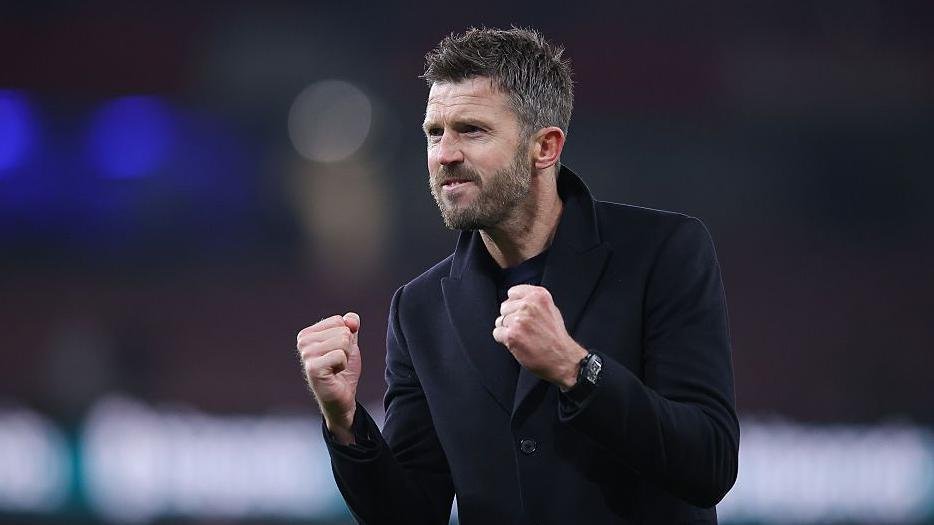

Manchester United fans have a warm feeling washing over them after Michael Carrick's arrival brought with it two stunningly eye-catching wins.
Further down this page you'll find praise from the likes of Danny Murphy, Wayne Rooney and BBC Sport's Manchester United reporter Simon Stone.
But Carrick's start – packed with chances, attacking endeavour and what some point out is 'Manchester United DNA' – is just a start.
When Carrick left Middlesbrough in June, BBC Radio Tees’ Boro commentator Mark Drury said his dismissal was far from “knee-jerk”. Indeed, a body of evidence regarding his shortcomings had been built.
"His dismissal was a sign that despite how much everyone at Middlesbrough might have wanted it to work for Carrick, after nearly three years in charge he was judged to be more of the problem than the solution to their promotion woes," said Drury.
Middlesbrough supporter Dana Malt also served BBC Sport a warning when Carrick took over at Old Trafford. Her view was the patchy form Boro showed pointed to “a rookie head coach learning on the job”.
Malt explained Carrick's side slipped from a position of early promise across his almost three seasons in charge. There were huge plus points, with Malt saying a 3-2-5 formation when attacking "resulted in the best football I have seen a Middlesbrough team play", only for a slack defensive discipline to prove a negative feature that is hard to overcome.
"Boro had never been anywhere near watertight defensively under Carrick, but 2024-25 took the biscuit," she said. "We conceded comedic goals that the Benny Hill theme music would be a perfect match to. That was only one problem. Injuries struck again and, from January, Boro became a chore to watch. Ineffective, boring and one-dimensional. Carrick did not have the answers. He took us from fourth to eighth to 10th. He took us from the best football I had seen to arguably the most infuriating. I wanted him to turn it around, but he could not."
The early joy Carrick has delivered at Manchester United since taking caretaker charge has clearly been on display in his work previously. The issue has been maintaining early standards, upholding a style of play over a prolonged spell and – as is so often the way – having your best players available to execute what's being asked.
"At Middlesbrough, Carrick was reluctant to change his 4-2-3-1 system, looking to dominate the game through high possession," says BBC Sport football tactics correspondent Umir Irfan.
"When Middlesbrough had solid possession in the middle of the pitch, they would move into a 3-2-5 shape.
"Criticism of Ruben Amorim was heavily based on his 3-2-4-1 shape so it is interesting that Carrick likes his teams to attack in a similar way. No team in the Championship scored more goals in the league during Carrick's time as manager using these tactics. They dominated possession most games and their approach was measured as they looked to unpick teams.
"Although they favoured possession, when the opportunity to pass the ball more directly opened up, players were encouraged to play at speed. They scored often from fast breaks but this was mainly after the opposition turned the ball over in dangerous areas.
"Player quality and outgoing transfers meant these moments became less frequent in Carrick's final season.
"The main critique was that they became too slow and predictable on the ball. That and the space they would leave defensively, if they attacked or pressed too aggressively.
"With better player quality, the hope is that United can build upon Carrick's clear shape with players who can exploit spaces that open up. The likes of Lisandro Martinez, Bruno Fernandes and Kobbie Mainoo's ability to speed up play can be valuable here."





