
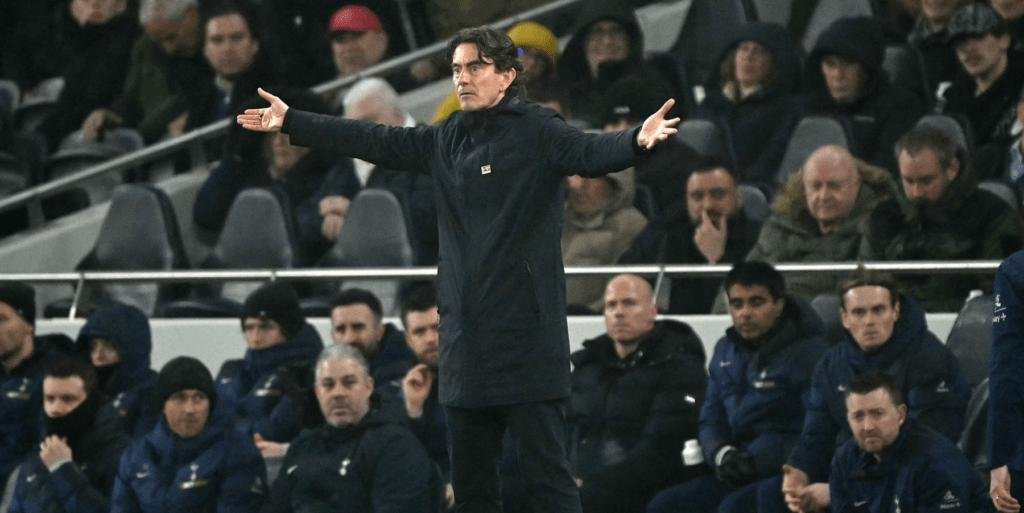
Tottenham have sacked Thomas Frank after sliding towards the relegation zone with a dreadful run of results. However, the truth is the writing has been on the wall for months.
Given how dreadful results have been, how toxic the atmosphere has become at the Tottenham Hotspur Stadium, and how utterly hopeless the players look, it shouldn’t have been a surprise that Thomas Frank was sacked as Spurs manager on Wednesday morning.
Following Tuesday night’s woeful performance in defeat to Newcastle, the Tottenham board finally lost patience with the manager who boasts the worst win rate in the club’s Premier League history.
But the hierarchy had been steadfast in their position that they would ride this out, and stick by the man they trusted to take them forward for the long term. The thinking, it seemed to be, was that the previous Tottenham regime, led by the now-departed Daniel Levy, had been too trigger-happy with firing and hiring managers. The club needed continuity and stability to build something sustainable that would last longer than any of the previous failed eras since Mauricio Pochettino left the club in 2019.
They might have been right. Short-term thinking had got Spurs nowhere with José Mourinho and Antonio Conte. They have gone backwards since sacking Ange Postecoglou. Maybe Frank would have one day turned it around and gone on to bring long-term success to Tottenham.
But having given him as long as possible to prove he was the man for the job – and convinced many observers that they would keep him in position in the face of historically bad results – even the Spurs board have now realised they got this one wrong.
Astonishingly, given the size of the club now and how persistently poor they were in the early years of the Premier League, Frank oversaw the worst period in Tottenham’s history in the competition. He leaves the club having averaged the lowest points per game (1.12) and win rate (26.9%) of any Spurs manager to take charge of at least five Premier League games.

Just look at the list of names he is alongside for the worst numbers among Tottenham managers, and nobody else from the modern era appears. Even Postecoglou, who oversaw a 17th-placed finish last season, is nowhere to be seen. It’s a shocking fall for a club who were Champions League regulars only a few seasons ago.
But even if those in charge of the club were desperate for this appointment to succeed, it has been obvious for a long time to almost anyone watching that this was never going to work.
On the back of an incredibly impressive body of work at Brentford, Frank was brought in to shore up a defence that had been too leaky under Postecoglou, but in trying to do that – which he also ultimately failed to do adequately – he made Spurs almost completely inept in attack. They have averaged just 1.05 expected goals per game this season, which is more than only three other teams, in Sunderland, plus bottom two, Burnley and Wolves. They have scored 36 goals, which is fewer only than eight other teams, but that is largely because they have outperformed their xG to a greater extent than any other team (+8.6). They have built nothing sustainable when it comes to their attacking play.
They didn’t create chances reliably at all under Frank, appearing to have little or no plan for progressing the ball up the pitch with the ball on the floor, despite patently having the players to do it. Spurs rank 14th out of 20 Premier League teams this season for both progressive passes (open-play successful passes played in the attacking two-thirds of the pitch that move the ball at least 25% closer to the goal) with 20.1 per game, and line-breaking passes, with 44.5 per game. There has been almost no attempt to control games by dominating the ball, and Spurs have been outplayed by many teams with far less in the way of resources than them.

When Frank came in, there was some relief among the fans that they now had a pragmatic manager who saw the value in making use of set-pieces after the idealism of Postecoglou. Long throws were introduced on day one, and set-piece routines were practised on the training ground.
Frank made Spurs into a force at dead balls at both ends of the pitch. They have scored 13 goals from corners this season, leaving them second only to Arsenal (14), and for that he deserves some credit. But they ultimately became too reliant on those situations, scoring a higher proportion of their goals from set-pieces (36.1%) than any other team in the Premier League this season. Their 0.69 xG per game in open play is higher than only four other teams (West Ham, Wolves, Burnley and Sunderland).

There was little on the pitch to inspire the fans, and as performances worsened through the winter months and Frank cut an increasingly clueless figure on the touchline, patience ran out.
Worse even than the way Tottenham had been playing were the results. Frank oversaw just two wins from his final 17 Premier League matches in charge, picking up a mere 12 points. That’s at least seven fewer than every other team in that time aside from the doomed Wolves (six) and Burnley (five).
Right now, they are winless in eight Premier League games, making this their longest such run since going nine without victory from May to October 2008 under Juande Ramos.
Relegation has become a real and terrifying possibility. Spurs have slid from third place after five games, when they made a distractingly positive start to life under Frank, to 16th on Wednesday morning, just five points clear of the relegation zone. West Ham in 18th have closed the gap by eight points over the past five matchdays, so they have every chance of catching up in the space of the 12 games that remain this season.
Particularly painful has been Spurs’ woeful home form. The club charges some of the highest ticket prices in the country but have given fans only two home wins in 13 league games all season. Frank hasn’t given them much reason to keep coming back, and the swathes of empty seats at the stadium at every recent home game might have gone some way to scaring the club into acting.
There is the fact Frank has had to deal with an atrocious injury crisis. After Wilson Odobert went off against Newcastle, Spurs now have 11 first-team players out, plus they are also without captain Cristian Romero for another three games after his red card at Manchester United at the weekend.
But there is no way this group – even accounting for only the fit and available players – are anywhere near as bad as their performances and results have been. They look completely shot of confidence, devoid of ideas under a manager who hasn’t given them any good ones, and are steaming head first towards relegation. The ceiling for this team is much, much higher than they have made it look in recent weeks.
Given the club were so desperate for it to work out for Frank, there isn’t much hope that they have a replacement lined up, but there is a lot of potential to work with for whoever comes in. Half of the currently unavailable players could be back by mid-March, too.
It is then that Spurs face a two-legged last-16 tie in the Champions League, the final competition that could provide any hope of this season being anything other than a complete failure. Winning it is extremely improbable – almost impossible – but Spurs showed in finishing fourth in the league phase, as well as en route to Europa League glory last season, that they are capable of compartmentalising their miserable domestic form and beating decent European sides. They won’t be back in the competition any time soon, so they will want to make the most of it this season. A change in manager brings renewed hope that they won’t be crashing out in the next round.
The priority will of course be staving off the imminent threat of relegation, though. Spurs cannot entertain the possibility of going down. They are far too big a club to be in this position at all, so, starting with the north London derby in 11 days’ time, Premier League points are needed desperately.
Frank has left Spurs in this unthinkable position, and his appointment needs to be forgotten. Bringing him in was a huge mistake, but it doesn’t have to prove a costly one. There is enough of the season left and enough quality in the squad for Tottenham to recover. It’s just a good thing the board didn’t dig their heels in and let this go on any longer.

Enjoy this? Subscribe to our football newsletter to receive exclusive weekly content. You should also follow our social accounts over on X, Instagram, TikTok and Facebook.





